Computer Science
Definitions
Wikipedia’s Definition, as of early spring, 2026:
Computer science is the study of computation, information, and automation.
Nice and to the point. My definition is a little more expansive:
Computer Science is the theory and practice of computation, knowledge representation, language, intelligence, learning, and consciousness.
A shorter definition, relating it to other broad fields of study:
- Philosophy
- is concerned with the search for fundamental truths of the universe using logic (reasoning).
- Mathematics
- is concerned with reasoning using models and abstract patterns.
- Computer Science
- is concerned with automating the reasoning process.
The latter definition makes clear that artificial intelligence, and in particular generative AI, is a subfield of computer science.
Artificial Intelligence is a subfield of Computer Science.
This is probably worth repeating:
Artificial Intelligence is a subfield of Computer Science.
Please read what Wikipedia has to say about Computer Science. This is a great article, and does a great job explaining the field and dispelling common misconceptions.
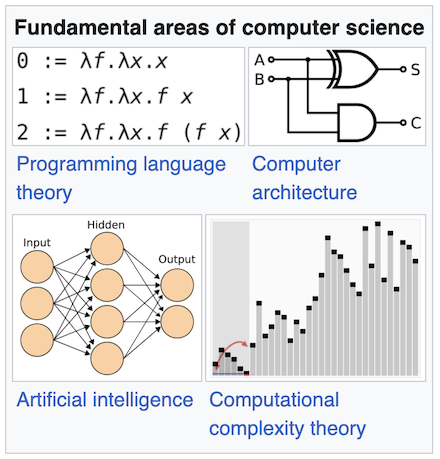
Questions Computer Scientists Ask
These are the questions that characterize computer science:
- What can and can not be computed?
- How fast can a certain computation be carried out?
- How much information is needed to carry out a certain computation?
- How can information be efficiently (and securely) encoded, stored, retrieved, and transmitted?
- How do we design programs?
- How do we know a program is correct?
- How can computational theories help explain intelligence and consciousness?
None of these requires a computer to answer, right?
Wait—there’s one more question: Does P = NP?
What Computer Scientists Do
In case anyone asks you, computer scientists:
- Architect large software systems, i.e., identify the components and their behavior and interaction (this requires skill and enormous experience)
- Organize information into data structures for efficient processing
- Devise algorithms to carry out the specified behavior of the components (this is a creative, artistic process)
- Express algorithms (this is called programming)
- Validate algorithms (using formal proof and heavy mathematics)
- Analyze algorithms (usually to determine whether they satisfy efficiency constraints)
- Test code (to increase confidence that a system meets its specification)
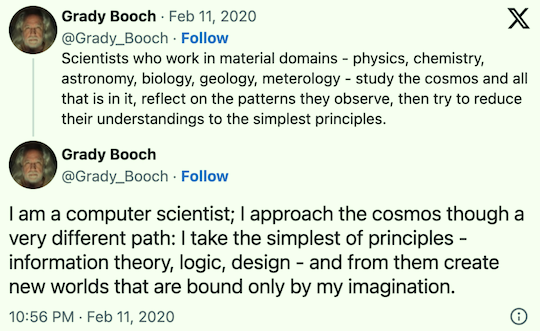
Here’s a more poetic answer to what computer scientists do:
Subject Areas
The ACM, IEEE-CS and the AAAI have gotten together and defined a set of knowledge areas for computer science.
| Knowledge Area | Code | Some Topics |
|---|---|---|
| Algorithmic Foundations | AL | Foundational Data Structures and Algorithms • Algorithmic Strategies • Complexity Analysis • Computational Models and Formal Languages • Algorithms and Society |
| Architecture and Organization | AR | Digital Logic and Digital Systems • Machine-Level Data Representation • Assembly Level Machine Organization • Memory Hierarchy • Interfacing and Communication • Functional Organization • Performance and Energy Efficiency • Heterogeneous Architectures • Quantum Architectures |
| Artificial Intelligence | AI | Fundamental Issues • Fundamental Knowledge Representation and Reasoning • Machine Learning • Applications and Societal Impact • Probabilistic Representation and Reasoning • Planning • Logical Representation and Reasoning • Agents • Natural Language Processing • Robotics • Perception and Computer Vision |
| Data Management | DM | The Role of Data • Core Database Systems Concepts • Data Modeling • Relational Databases • Query Construction • Query Processing • DBMS Internals • NoSQL Systems • Data Security & Privacy • Data Analytics • Distributed Databases • Cloud Computing • Semi-structured and Unstructured Databases • Society, Ethics, and Professionalism |
| Foundations of Programming Languages | FPL | • Compiled vs Interpreted Languages • Scripting • Object-Oriented Programming • Functional Programming • Logic Programming • Event-Driven and Reactive Programming • Parallel and Distributed Computing • Type Systems • Systems Execution and Memory Model • Language Translation and Execution • Program Abstraction and Representation • Syntax Analysis • Compiler Semantic Analysis • Program Analysis and Analyzers • Code Generation • Runtime Behavior and Systems • Advanced Programming Constructs • Language Pragmatics • Formal Semantics • Formal Development Methodologies • Design Principles of Programming Languages • Quantum Computing |
| Graphics and Interactive Techniques | GIT | Fundamental Concepts • Rendering • Geometric Modeling • Shading • Computer Animation • Visualization • Immersion (MR, AR, VR) • Interaction • Image Processing • Tangible/Physical Computing • Simulation |
| Human-Computer Interaction | HCI | Understanding the User • Accountability and Responsibility in Design • Accessibility and Inclusive Design • Evaluating the Design • System Design |
| Mathematical and Statistical Foundations | MSF | Discrete Mathematics • Probability • Statistics • Linear Algebra • Calculus |
| Networking and Communication | NC | Networked Applications • Reliability Support • Routing And Forwarding • Single-Hop Communication • Mobility Support • Network Security |
| Operating Systems | OS | Role and Purpose of Operating Systems • Principles of Operating System • Concurrency • Protection and Safety • Scheduling • Process Model • Memory Management • Device Management • File Systems API and Implementation • Virtualization • Real-time and Embedded Systems • Fault Tolerance |
| Parallel and Distributed Computing | PDC | Parallel Programs • Parallel Communication • Parallel Coordination • Parallel Evaluation • Parallel Algorithms |
| Security | SEC | Foundational Security • Defensive Programming • Cryptography • Security Analysis and Engineering • Digital Forensics • Security Governance |
| Society, Ethics, and the Profession | SEP | Social Context • Methods for Ethical Analysis • Professional Ethics • Intellectual Property • Privacy and Civil Liberties • Communication • Sustainability • History • Economies of Computing • Security Policies, Laws and • Computer Crimes • Equity, Diversity and Inclusion |
| Software Development Fundamentals | SDF | Fundamental Programming Concepts and Practices • Development of Fundamental Data Structures • Development of Algorithms • Software Development Practices |
| Software Engineering | SE | Teamwork • Tools and Environments • Product Requirements • Software Design • Software Construction • Software Verification and Validation • Refactoring and Code Evolution • Software Reliability • Formal Methods |
| Specialized Platform Development | SPD | Web Platforms • Mobile Platforms • Robot Platforms • Embedded Platforms • Game Platforms • Interactive Computing Platforms |
| Systems Fundamentals | SF | Basic Concepts • Resource Allocation and Scheduling • System Performance • Performance Evaluation • System Reliability • System Security • System Design |
See, again, AI is just a subfield of Computer Science.
More Subject Areas
Here’s a finer breakdown of subject areas within computer science:
- Agent Orchestration
- Bioinformatics (Computational Biology)
- Cloud Computing
- Compilers and Interpreters
- Computation Theory
- Computer Architecture
- Computational Complexity
- Computational Geometry
- Data Mining
- Data Structures
- Databases
- Decision Support Systems (Knowledge-Based Systems)
- Distributed, Parallel, and Cluster Computing
- Digital Libraries
- Generalized Learning
- Genetic Algorithms
- Graphics
- Human Computer Interaction
- Inference
- Information Theory
- Knowledge Representation
- Language Models
- Machine Learning
- Multiagent Systems
- Multimedia
- Natural Language Processing
- Networks and Internets
- Neural and Evolutionary Computing
- Numerical Analysis
- Operating Systems
- Program Verification
- Programming Languages
- Quantum Computing
- Real-time Systems
- Reasoning under Uncertainty
- Robotics
- Scientific (Numeric, Symbolic) Computation
- Search and Information Retrieval
- Security (including Cryptography and Cryptanalysis)
- Software Engineering
- Speech Recognition
- Speech Synthesis
- Ubiquitous Computing
- Virtual Reality (and Virtual Worlds)
- Vision and Pattern Recognition
- Visualization
Recurring Concepts
Computer scientists have a deep understanding of the following concepts.
- Automation
- Binding
- Communication
- Complexity
- Consistency and Completeness
- Efficiency
- Evolution
- Formal Models
- Levels of Abstraction
- Ordering in Space
- Ordering in Time
- Reuse
- Security
- Tradeoffs and Consequences
If these seem abstract, it’s because they are. Computer Science is an academic discipline. There is a real science there. And nearly every computer scientist has become familiar with the following quote, attributed to E. W. Dijkstra:
Computer science is no more about computers than astronomy is about telescopes.
Kinds of Software
People use principles form computer science to create lots of different types of systems. Here’s a rough list of (overlapping) software system categories:
- Information Systems that create, store, retrieve, manipulate, present, and destroy information (such as in databases).
- Technical Systems such as control equipment in telecommunication, military, or industrial production.
- Embedded Real-time Systems which deal with physical sensors and actuators; you see these most often in run in cars, aircraft, appliances, etc.
- Distributed Systems which contain many different physical computers connected via some network.
- System Software, which is the low level code for operating systems, database systems, and user interfaces.
- Application Software like games or word processors, which run on desktops, laptops, and mobile devices.
Speaking of software, it’s useful to point out that software runs on many different kinds of devices, and computer scientists need to take into account how people use these devices when writing software for them. Devices include:
- Desktops
- Laptops
- Phones
- Tablets
- Robots
- Drones
- Smart TVs
- Game consoles
- Machinery
- All kinds of crazy things
Related Fields
Computer science borrows from, and touches, a whole lot of other fields, including:
- Linguistics (probably the closest relative)
- Biology (computational biology, biological databases, etc.)
- Psychology (we’d like computers to think like us, and perhaps understand us)
- Electrical Engineering (because face it, electronic components make good computing devices!)
- Mathematics (especially Discrete Math, Game Theory, etc.)
- Education (because both fields are concerned with knowledge representation and learning)
- Philosophy (especially Logic, Epistemology, Philosophy of Mind)
- Economics (think markets!)
- Sociology (computers in society, social networking, Second Life and other virtual environments)
- Animation
See, there’s no “AI” on this list.
Artificial Intelligence is a subfield of Computer Science.
People
Wikipedia has a list of famous computer scientists. If you want to read about some of these people, don’t skip Alan Turing, Grace Hopper, and Alan Kay.




Two Big Ideas
You’ve undoubtedly noticed, when using your phone, tablet, or laptop, all your programs are running on the same device. You don’t need a separate machine for each of those different things! You don’t need one machine for adding numbers, one for communicating by voice to other people, one for telling the current time, one for telling you how far away your destination is, one for finding the number of days between two dates, one for maintaining your TO-DO list, one for telling you your current direction, one for timers and alarms, one for translating Irish poems into Swahili; you get the idea.
You just need one machine.
But this was not always obvious. It was not obvious until the 1930s or later. People had to ask the deep question “What even is computation?” and get it onto a formal footing, for the field of Computer Science to arise. Alan Turing answered that question by representing computation as a “machine” described as a mathematical object. Then he showed every machine could be simulated by a single machine (since named the Universal Turing Machine in his honor).
That was stunning. Brilliant. The first big idea is universality.
There’s another big idea: Turing (and others, independently) showed that there were some questions that could not be answered, or decided by any machine. The second big idea, then, is called undecidability.
Wikipedia has a big list of undecidable problems.
Two big ideas in computer science are universality and undecidability.
Summary
We’ve covered:
- Definitions of Computer Science
- AI is a subfield of computer science
- What computer scientists are concerned with and what they do
- Subject areas and recurring concepts
- Which fields are related to computer science
- Two big ideas in CS: (1) universal computing machines exist, and (2) not every question can be decided by a computer