Set Theory
Why Sets?
We want to put math on a solid foundation so we know that we are not talking nonsense.
If we can reduce everything down to a few very basic concepts and rules that people can agree upon, then show how to carefully and systematically derive all of mathematics from them, building things up in a way everyone can agree is valid, we can have confidence that mathematics does what it is supposed to do.
For many people, sets are the basic concept.
A set is a carefully constructed collection of objects. In most set theories, sets contain only other sets as elements. Sets all the way down. This gives sets a very minimal feel—great for a foundational concept.
It is kind of surprising that this works, but it does.
History
Many, many histories of the development of Set Theory have been written. Thousands, probably. But the big event that you really need to know was this: Gottlob Frege was working on a project in which the idea of a set as any collection of objects defined by a property was central. Bertrand Russell wrote to him and pointed out that allowing sets for any conceivable property allowed for the self-contradictory set of all sets that do not contain themselves, now known as Russell’s Paradox. A set cannot just be any collection.
So what to do about this? We have to construct, somehow, a rigorous theory of sets that is free of this (and all other, we hope) paradoxes. Different folks have proposed ways to do so, leading to different theories of sets. Some, like ZF and its relatives, make self-containing sets impossible to write. Some, like NF, allow such sets but get around the root problem with stratification. Others, like NBG, distinguish sets and classes.
There are other ways in which set theories differ from each other. Some set theories allow for the existence of items that are not sets, but that can be members of sets. They’re called urelements. ZFC explicitly rejects these because foundations are simpler without them, and they don’t really add any expressive power.
Here are a few theories that are particularly notable:
- ZF and ZFC: Zermelo-Fraenkel Set Theory, with ZFC being the version that includes the Axiom of Choice. The most widely-known and studied set theory, forming, for many people, the standard foundation for much of modern mathematics. Avoids Russell’s Paradox by completely disallowing self-containing sets.
- NBG: Von Neumann–Bernays–Gödel Set Theory. A set theory that extends ZF by distinguishing sets and classes, where classes can be collections of sets that are too large to be sets themselves, avoiding Russell’s paradox. One awesome feature is that it is finitely axiomatizable, unlike ZF, which requires (as we’ll see below) axiom schemas.
- NF and NFU: New Foundations and New Foundations with Urelements. Uses stratification to avoid paradoxes while allowing some self-containing sets. Like NBG, it is finitely axiomatizable. Created by the logician W. V. Quine.
- MK: Morse–Kelley Set Theory. Closely related to NBG, distinguishing sets and classes, but not finitely axiomatizable.
- KP: Kripke–Platek Set Theory. Roughly the predicative part of ZFC and thus much weaker.
- CST: Constructive Set Theory. A set theory compatible with constructive mathematics, i.e., mathematics that avoids the law of excluded middle.
ZFC is the Big OneThe bulk of these notes will cover ZFC. We may, rarely, if at all, talk about other ones. ZFC is really a standout. It’s the one most people know, and the one most people think of when they think of Set Theory. If we ever talk about a different theory, we’ll be sure to point out that we are doing so.
And oh yeah, ZFC has even been called One of Humankind’s Great Inventions
Basic Notation
Time to get formal.
Surprisingly, all we need is $\in$.
Let’s begin with notation:
- $x \in A$ is defined to mean $x$ is an element of $A$.
- $x \notin A$ sugars $\neg(x \in A)$, and is read “$x$ is not an element of $A$.”
- $A \subseteq B$ sugars $\forall x. x \in A \supset x \in B$, and is read “$A$ is a subset of $B$.”
There is a lot of notation in Set Theory, so more sugar will be warranted. We’ll be using:
$\begin{array}{lcl} \forall x \in A. P & \textrm{to sugar} & \forall x.\, x \in A \supset P \\ \exists x \in A. P & \textrm{to sugar} & \exists x.\, x \in A \land P \\ \forall x\,y \in A. P & \textrm{to sugar} & \forall x. \forall y.\, x \in A \land y \in A \supset P \\ \exists x\,y \in A. P & \textrm{to sugar} & \exists x. \exists y.\, x \in A \land y \in A \land P \\ \end{array}$
Other notation will be defined as needed.
The Axioms of ZFC
A formal theory needs a syntax, a semantics, and inference rules. Recall (from our notes on logic) that inference rules without premises are called axioms. ZFC is pretty much a formal theory that adds axioms specifically for sets on top of first-order predicate logic.
There are many ways to choose the axioms of ZFC. Here we’re listing many that are well-known. They are not all mutually exclusive (i.e., some can be derived from others), but they are internally consistent and cover everything that should be covered, and that’s all that matters.
We haven’t defined functions yet, but thinking in terms of functions makes the axiom a bit easier to understand. We’ll go deeper into this in class to understand how the intuitive notion of a function is captured by the axiom.
Unlike the other axioms, this one is philosophically controversial. It asserts the existence of a choice function without telling you how to construct one—and for infinite (especially uncountable) collections of sets, there may be no way to describe such a function explicitly. You’re just allowed to assume it exists.
Encoding Objects in ZFC
Now we know what sets are. To have Set Theory as a foundation for mathematics, we need to be able to encode every mathematical object as a set. But how?
Overview
Here are some encodings people have invented in the set theory ZFC:
| Object | Encoding in ZFC |
|---|---|
| Natural Numbers | $0 = \varnothing$ $1 = \{0\} = \{\varnothing\}$ $2 = \{0, 1\} = \{\varnothing,\{\varnothing\}\}$ $3 = \{0,1,2\} = \{\varnothing,\{\varnothing\},\{\varnothing,\{\varnothing\}\}\}$ $4 = \{0,1,2,3\}$ ... $n = \{0,1,2,\ldots,n-1\}$ ... |
| Booleans | $\textsf{false} = 0$ $\textsf{true} = 1$ |
| Ordered Pairs | $(a, b) = \{\{a\}, \{a, b\}\}$ |
| Tuples | Ordered pairs that “nest” to the right |
| Relations | Sets of ordered pairs |
| Functions | Relations in which each left element is unique |
| Structures | Custom arrangements of elements often with tags that carry meaning in a given context |
| Sequences | Functions from $\{0, 1, \ldots, n\}$ to some set, representing an ordered list of elements |
| Lists | Nested pairs in which the innermost pair has the form $(x, \varnothing)$ |
| Characters | Natural numbers (interpreted as code points) |
| Strings | Lists of characters |
| Integers | Sets of all pairs of natural numbers $(a, b)$ with the same difference $a - b$ |
| Rational Numbers | Sets of all pairs of integers $(a, b)$ with $b \neq 0$ with the same quotient $\frac{a}{b}$ |
| Real Numbers | Sets of rational numbers with no lower bound, no greatest element, and for any rational number in the set, contains all rational numbers less than that value |
Details will come momentarily. For now, simply appreciate that everything does seem to be encodable with sets, which is why Set Theory has become so effective and popular.
As we go through these encodings, you’ll note that many different kinds of objects have the same structural encodings, but their behaviors may be radically different. The following two exercises should help illustrate this point.
Encoding Natural Numbers
The Axiom of Infinity states that a certain infinite set exists, one we call $\mathbb{N}$, We call the elements of this set the natural numbers and denote them $0, 1, 2, 3, \dots$. Formally, $0$ is the empty set $\varnothing$, $1$ is $\{\varnothing\}$, $2$ is $\{\varnothing, \{\varnothing\}\}$, and so on, with each number being the set of all preceding numbers.
This is worth stating again. Any natural number $n$ is encoded as:
$$ \{ 0, 1, 2, \dots, n-1 \} $$Interesting this works for $0$, which is encoded as $\varnothing$.
Encoding Booleans
In ZFC, the value $\textsf{false}$ is encoded as 0, and $\textsf{true}$ is encoded as 1.
We call the set of all boolean values $\mathbb{B}$, so $\mathbb{B} = \{\textsf{false}, \textsf{true}\}$. Note that this is indeed $\{ 0, 1 \}$, which is, you no doubt recalled from just seconds ago, just $2$.
Encoding Pairs
A pair is a ordered collection of two elements. Since it is ordered, we cannot just encode $(a,b)$ as $\{a,b\}$, because $\{a,b\} = \{b,a\}$ by the Axiom of Extensionality. So we have to come up with something better.
Kuratowski found a good encoding, which is the most common one used today: the pair $(a,b)$ is represented as the set $\{\{a\}, \{a,b\}\}$.
The encoding works great in practice, but gives off strange vibes if you look too closely.
RelaxSuch oddities are a natural result of building everything from sets. One need only worry about encodings when dealing with foundations; in practice, separate all the different kinds of objects into different kinds of things and don’t mix them up. It’s not that hard.
Let’s define something to make our lives easier. The set of all pairs $(a, b)$ whose first element comes from $A$ and the second from $B$ will be denoted $A \times B$. We can define it as:
$$A \times B =_{\small{\textrm{def}}} \{ z \in \mathcal{P}(\mathcal{P}(A \cup B)) \mid \exists a \in A. \exists b \in B. z = (a, b) \}$$Again, this is just an encoding. You may sometimes see folks write:
However, this is not legal, since (the Axiom of Separation tells us) the left-hand side of the $\mid$ must be an expression of the form $x \in S$ where $S$ is an existing set (of which we are trying to make a subset from), but in this failed definition this set is implicitly...$S$ itself—the set they are trying to define. However, once $A \times B$ is properly defined, it can be used as a set that can be subsetted.
Here’s more sugar. We can pattern match on the left-hand side tuple pattern writing:
$$\{(a, b) \in A \times B \mid a = b\}$$for:
$$\{z \in A \times B \mid \exists a. \exists b. z = (a, b) \land a = b\}$$Pairs are going to come up very often.
Encoding Tuples
Since tuples are pairs, the encoding of tuples in ZFC uses the encoding for pairs.
Since we are allowing syntactic sugar for tuple objects, we can extend this idea to the $\times$ operator itself, taking it to be right-associative: $A_1 \times A_2 \times \ldots \times A_n$ means $A_1 \times (A_2 \times (\ldots \times A_n)\ldots)$.
Should we speak loosely of $1$-tuples and $0$-tuples, a $1$ tuple simply is the object itself and needs no special encoding. The $0$-tuple is the unit object $()$, which we will encode as $\varnothing$.
Encoding Relations
In ZFC, a relation is a subset of a cross product. That’s it. That’s the whole definition.
For the relation $R \subseteq A \times B$, we say $A$ is the domain and $B$ is the codomain. If $(a,b) \in R$ we write $aRb$. The inverse $R^{-1} \subseteq B \times A$ is $\{(b,a) \mid aRb\}$.
Here is the definition of the less-than relation on natural numbers in ZFC:
Note that because a relation is a subset of $A \times B$, the set of all relations over $A$ and $B$ is $\mathcal{P}(A \times B)$.
Now we can define composition. If $R \subseteq A \times B$ and $S \subseteq B \times C$ then the composition of $R$ and $S$ is $S \circ R$ = $\{(a,c) \mid \exists b. aRb \land bSc\}$.
The symbol $\circ$ can be read as “composed with” but it is much better read as “after”. For example, $S \circ R$ is best read as “$S$ after $R$.”
Even though relations are sets, the superscript notation on relations means something different than it does for regular sets. This seems infuriating until you finally come to terms with the fact that that math notation is very contextual and changes depending on what you are talking about. Anyway, here is what the superscripts mean for relations:
Those definitions imply $R^2 = R \circ R$, $R^3 = R \circ R \circ R$, and so on.
AMBIGUOUS NOTATION ALERTThe expression $R^2$ is ambiguous: since a relation is a set, $R^2$ could mean $R \times R$, but most people use it to mean $R \circ R$. You really need to supply context when using ambiguous notation.
Encoding Functions
In set theories like ZFC, where everything is a set, even functions, a function $f \subseteq A \times B$ is defined to ba a relation in which every element of $A$ appears exactly once as the first element of a pair in $f$. That’s all it is.
If $f$ is a function and $(a,b) \in f$ we write $f a = b$, or $f(a) = b$, and say $b$ is the value of $f$ at $a$. The range of $f$ is $\{b \mid \exists a. b = f a\}$.
The set of all functions from $A$ to $B$ is denoted $A \rightarrow B$. You might also see $B^A$ used for this set.
Since functions are relations and therefore sets, we often write them in set notation, but you may prefer to use $\lambda$ notation, which shows how inputs are mapped to outputs. Here you provide a logical formula after the dot which provides the output after substituting the input into the formula.
It might go without saying, but because functions are relations, the “after” operation applies to functions. An example:
$$ (\textsf{square} \circ \textsf{inc}) (3) = \textsf{square}(\textsf{inc}(3)) = \textsf{square}(4) = 16 $$ $$ (\textsf{inc} \circ \textsf{square}) (3) = \textsf{inc}(\textsf{square}(3)) = \textsf{inc}(9) = 10 $$So does iteration (since again, functions are just relations):
$$ \begin{array}{l} \textsf{inc}^0 (5) = 5 \\ \textsf{inc}^1 (5) = \textsf{inc}(5) = 6 \\ \text{inc}^2 (5) = (\textsf{inc} \circ \textsf{inc}) (5) = \textsf{inc}(\textsf{inc}(5)) = 7 \\ \textsf{inc}^3 (5) = (\textsf{inc} \circ \textsf{inc} \circ \textsf{inc}) (5) = \textsf{inc}(\textsf{inc}(\textsf{inc}(5))) = 8 \\ \ldots \\ \textsf{inc}^{-1} (5) = 4 \\ \end{array} $$When we encode relations as sets, we can give formal definitions for surjections, injections, and bijections:
- $f$ is a surjection (i.e., $f$ maps $A$ onto $B$) iff $\forall b\in B. \exists a\in A.\,f a = b$
- $f$ is an injection (i.e., $f$ maps $A$ one-to-one to $B$) iff $\forall a\in A. \forall b\in A.\, a \neq b \supset f a \neq f b$
- $f$ is a bijection, a.k.a. a one-to-one correspondence iff $f$ is a surjection and an injection
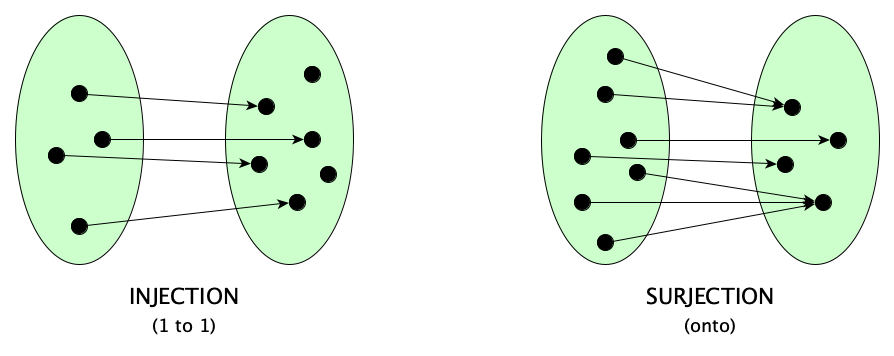
If $f$ is a bijection from $A$ to $B$, then:
- $f^{-1}$ is a bijection from $B$ to $A$
- $\forall a. f^{-1}(f\,a) = a$
- $\forall b . f(f^{-1}\,b) = b$
Encoding Partial Functions
Strictly speaking, a function in ZFC is a relation where every element of the domain appears exactly once as the first element of a pair. If we relax this to every element of the domain appearing at most once then we have a partial function. Think of a partial function as not being able to compute a value for every element, or one in which the value at some inputs is not defined. For emphasis, functions that are defined everywhere are called total functions.
The set of all partial functions from $A$ to $B$ is denoted $A \rightharpoonup B$.
If $f \in A \rightharpoonup B$ then:
- $f \in C \rightarrow B$ for some $C \subseteq A$, where $C$ is precisely the set of elements from $A$ at which $f$ is defined.
- $f \in A \rightarrow B \cup \{\bot_B\}$, where $\bot_B$ is a representation of the undefined value in $B$.
The subscript on $\bot_B$ is often omitted in practice and inferred from context.
Encoding Sequences
In ZFC, the sequence $\langle a_0, a_1, a_2, \dots, a_{n-1} \rangle$ is encoded as a partial function from the natural numbers $\mathbb{N}$ to some set $A$, where the function returns a sequence element for the first $n$ natural numbers and $\bot$ thereafter. To get the element at position $i$ in sequence $s$, we simply evaluate $s(i)$.
Alternatively, a sequence can be encoded as a total function with domain $\{ 0, 1, \ldots, n-1\}.$
Encoding Lists
In ZFC, a list is defined inductively like so: The empty list is represented by $\varnothing$, and a non-empty list is represented as an ordered pair whose first element is the head of the list and the second element is the tail (which is itself a list). So the list $[3,8,5]$ would be represented as $(3, (8, (5, \varnothing)))$.
The head and tail functions on lists are partial functions.
Encoding Strings
Strings in ZFC are encoded as lists of characters, where a character is an element of a set known as an alphabet. An example of an alphabet is the set $\textsf{Unicode}$. The ZFC representation of the string $hi$ is $(\texttt{LATIN SMALL LETTER H}, (\texttt{LATIN SMALL LETTER I}, \varnothing))$, or $(\texttt{U+0068}, (\texttt{U+0069}, \varnothing))$.
The context surrounding strings is so vast, we have a separate page of notes on the topic. It is part of a much larger theory of language and computation, which we will explore in detail later in the course.
Encoding Maps
In ZFC, we encode maps as partial functions from their key set to their value set.
Encoding Integers and Rationals
Recall that the encoding of natural numbers comes from the ZFC Axiom of Infinity:
$$ \begin{array}{lcl} \mathbb{N} & = & \{ \varnothing, \{\varnothing\}, \{\varnothing, \{\varnothing\}\}, \{\varnothing, \{\varnothing\}, \{\varnothing, \{\varnothing\}\}\}, \ldots \} \\ & = & \{0, 1, 2, 3, \dots\} \end{array} $$We use natural numbers as the building blocks to encoding integers and rationals. The intuition behind these encodings is:
- An integer is encoded as a set of pairs $(a, b)$ from $\mathbb{N} \times \mathbb{N}$, such that, say, the integer $3$ is encoded as $\{ (3,0), (4,1), (5,2), \dots \}$ and the integer $-2$ is encoded as $\{ (0,2), (1,3), (2,4), \dots \}$. The set of all integers is called $\mathbb{Z}$.
- A rational number is encoded as a set of pairs $(a, b)$ from $\mathbb{Z} \times \{z \in \mathbb{Z} \mid z \gt 0\}$, such that, say, the rational number $\frac{3}{4}$ is encoded as $\{ (3,4), (6,8), (9,12), \dots \}$ and the rational number $-\frac{2}{5}$ is encoded as $\{ (-2,5), (-4,10), (-6,15), \dots \}$. The set of all rational numbers is called $\mathbb{Q}$.
But to make this formal, we need to define what we mean by addition and multiplication for natural numbers within ZFC.
Here is the successor function on natural numbers in ZFC:
$$ S =_{\small{\textrm{def}}} \{ (x,y) \in \mathbb{N} \times \mathbb{N} \mid y = x \cup \{x\} \} $$Now addition on natural numbers in ZFC is the smallest relation that satisfies the properties of addition:
$$ + =_{\small{\textrm{def}}} \bigcap \left\{ R \in \mathcal{P}((\mathbb{N} \times \mathbb{N}) \times \mathbb{N}) \ \middle|\ \begin{array}{l} (\forall m \in \mathbb{N}. \, (m, 0)\,R\, m) \; \land \\ (\forall m, n, k \in \mathbb{N}. \, (m, n)\,R\, k \supset (m, S(n))\,R\, S(k)) \end{array} \right\} $$Now we can formally define the sets of integers and rational numbers:
Encoding the Real Numbers
Real Numbers are pretty wild, and require some cleverness to define set-theoretically. The trick is to model a real as a set of all rational numbers less than the number we are defining—more precisely, a bounded, downward-closed (if $x$ is in the set and $y$ is a rational number less than $x$, then $y$ is also in the set) set of rationals that is neither $\varnothing$ or $\mathbb{Q}$ itself, called a Dedekind Cut. Specific examples are:
The set of all real numbers:
Naturally, we’d like to see how to define addition, subtraction, multiplication, division, and exponentiation on the integers, rational numbers, and real numbers, but alas, that’s beyond the scope of these notes, but it easy to find.
Cardinal Numbers
A cardinal number tells us how many of something there are. In particular, it helps us count how many items there are in a set. Cardinality, and cardinal numbers, are one of the most important and fundamental concepts in Set Theory.
They also show up in computability theory, since one of the central results of that theory is that there are more functions than programs. That’s interesting. But how do we know this?
The quantity of elements in a set is called the cardinality of the set. The cardinality of set $A$ is denoted $|A|$ and obeys these axioms:- $|A| = |B|$ iff there exists a bijection between $A$ and $B$. That is, for each element in $A$ there is a matching value in $B$ and vice-versa.
- $|A| \leq |B|$ iff there exists an injection from $A$ to $B$. That is, for each element of $A$ there is a matching element in $B$, but not necessarily vice-versa.
- $|A| \lt |B|$ iff $|A| \leq |B|$ and $|A| \neq |B|$
Did you notice something about bijections? They are important! They tell us when two sets are the same size, without having to count them.
Matching is more fundamental than counting.
Think about thisMatching is more fundamental than counting. Imagine yourself without words for what we now call numbers. You could still come up with ideas of greater than or less than, and allocate resources, and even trade.
Counting is an advanced concept!
If there exists a bijection between a set $A$ and the set $\{1, 2, ... k\}$ for some natural number $k \geq 0$, we say that $A$ is finite and, since the number of elements in $\{1, 2, ... k\}$ is $k$, we have $|A| = k$.
What about $\mathbb{N}$? We can’t find a bijection between that and $\{1, 2, ... k\}$ for any natural number $k$. That set is not finite—it is infinite. So what is its cardinality? Someone once declared it to be $\aleph_0$ and this decree stuck. $\aleph_0$ a cardinal number. Not a natural number, but definitely a cardinal, because it tells you how many of something there is.
We can make a bijection between the set of even numbers and the set of natural numbers using the function $\lambda n_{\small{\mathbb{N}}}. 2n$. So the set of even numbers has the same cardinality as the set of natural numbers. It too has a cardinality of $\aleph_0$.
An interesting thing about $\mathbb{N}$ is that you can list, enumerate, or count them—yes it would take forever, but you could do it in principle. The is so significant that we have a definition:
A set $A$ is countable (a.k.a. listable) iff $A$ is finite or $|A| = \aleph_0$. $\mathbb{N}$ is countable by definition. We saw that the even natural numbers are countable. So is $\mathbb{Z}$, because $\lambda n.(\textsf{if}\;\textit{even}(n)\;\textsf{then}\;\frac{-n}{2}\;\textsf{else}\;\frac{n+1}{2})$ is a bijection between $\mathbb{N}$ and $\mathbb{Z}$.
$\mathbb{N} \times \mathbb{N}$ is countable, too:
  (0,0)
  (0,1)   (1,0)
  (0,2)   (1,1)   (2,0)
  (0,3)   (1,2)   (2,1)   (3,0)
  (0,4)   (1,3)   (2,2)   (3,1)   (4,0)
  (0,5)   (1,4)   (2,3)   (3,2)   (4,1)   (5,0)
  ...
By a similar argument, $\mathbb{Q}$, $\mathbb{N}^i$, and any countable union of countable sets are all countable.
But the set of real numbers is associated with a bigger infinity. We prove this with a technique known as diagonalization, which basically says that no matter how you try to list all real numbers, you can always construct a new real number that is not on the list.
Here’s a video explanation, together with some additional historical context:
The video shows that there are infinities “larger than” the infinity of the natural numbers. That is, there are cardinal numbers much greater than $\aleph_0$. Such sets are called uncountable. There are infinitely many larger and larger and larger infinities. You can show this by making power sets repeatedly. Why? Because Cantor’s theorem works for both finite (obviously) and infinite sets:
Cantor’s Theorem: For any set $A$, $|A| \lt |\mathcal{P}(A)|$. Proof: Clearly $|A| \leq |\mathcal{P}(A)|$, so we only have to show $|A| \neq |\mathcal{P}(A)|$. Proceed by contradiction. Assume $|A| = |\mathcal{P}(A)|$, which means there is a function $g$ mapping $A$ onto $\mathcal{P}(A)$. Consider $Y = \{x \in A \mid x \notin g(x)\}$. Since $g$ is an onto function, there must exist a value $y \in A$ such that $g(y)=Y$. If we assume $y \in Y$ then by definition means that $y \notin Y$. But if we assume $y \notin Y$, then that means $y \in Y$. This is a contradiction, so the assumption that a surjectve $g$ exists cannot hold. Therefore $|A| \neq |\mathcal{P}(A)|$. Slay.
Diagonalization againCantor’s theorem uses the same diagonalization technique as the proof that $|\mathbb{N}| \lt |\mathbb{R}|$.
Similar arguments to this proof of Cantor’s theorem show that the following sets are uncountable:
- $\{x \mid x \in \mathbb{R} \land 0 \lt x \lt 1\}$
- $\mathbb{N} \rightarrow \mathbb{N}$
Fun fact. Okay so $\{x \mid x \in \mathbb{R} \land 0 \lt x \lt 1\}$ is uncountable. But is its cardinality equal to, or strictly less than, $\mathbb{R}$ itself? Turns out it’s equal! The bijection you are looking for is: $\lambda x. \frac{1}{\pi}tan^{-1}x + \frac{1}{2}$ is a bijection to $\langle 0,1 \rangle$.
The continuum is a pretty mind-blowing concept.
The fact that $\mathbb{N}\rightarrow\mathbb{N}$ is uncountable means that there are functions for which no computer program can be written to solve, because programs are strings of symbols from a finite alphabet of characters (e.g., Unicode) and thus there are only a countably infinite number of them. Similarly, the fact that there are real numbers that we cannot describe is true because descriptions are themselves finite strings in some language.
The continuum is a pretty mind-blowing concept.
Alternate DefinitionsRather than defining finite sets as those can have a bijection with $\{1, 2, \ldots k\}$ for natural number $k$ and infinite sets as sets that are not finite, others prefer these definitions:
A set is infinite iff there is a bijection between it and a proper subset of itself. A set is finite iff it is not infinite.
Ordinal Numbers
It’s important to distinguish cardinals from ordinals. An ordinal number gives the position of something in an ordered sequence. While cardinal numbers are called, in English, zero, one, two, three, and so on, ordinal numbers are called first, second, third, and so on.
This video has great visuals for both kind of numbers. You may have encountered it in the Foundations of Mathematics notes. If you haven’t, watch it now:
Recall Practice
Here are some questions useful for your spaced repetition learning. Many of the answers are not found on this page. Some will have popped up in lecture. Others will require you to do your own research.
- What is Russell’s Paradox? The set of all sets that do not contain themselves cannot be a set, because if it contains itself, it should not contain itself, and if it does not contain itself, it should contain itself.
- How can one respond to Russell’s Paradox to create a consistent theory of sets? By restricting the kinds of sets that can be constructed, and by carefully defining what a set is.
- What are some set theories? Zermelo-Fraenkel-Choice (ZFC), Von Neumann–Bernays–Gödel (NBG), Morse–Kelley (MK), New Foundations (NF), Ackermann Set Theory, Kripke–Platek Set Theory, Constructive Zermelo–Fraenkel Set Theory (CZF), Zermelo Set Theory, Quine's New Foundations with Urelements (NFU).
- What is the characteristic notation of Set Theory? $x \in A$
- What is a set? A collection of distinct objects, carefully constructed to avoid nonsensical or paradoxical situations.
- What does the expression $A \subseteq B$ sugar? It is syntactic sugar for $\forall x (x \in A \rightarrow x \in B)$.
- What is the most popular set theory called? ZFC, for Zermelo-Fraenkel-Choice.
- Name some Axioms of ZFC Set Theory. Empty Set, Extensionality, Regularity, Pairing, Union, Power Set, Infinity, Separation, Replacement, Choice.
- What does the Axiom of Extensionality state? Two sets are equal if and only if they have the same elements.
- What does the Axiom of Regularity state? Technically, that every non-empty set $A$ contains an element that is disjoint from $A$. Its true purpose is to guarantee that sets are well-founded, meaning there are no infinite descending chains of sets.
- How is the natural number 1 represented in ZFC? $\{ \emptyset \}$.
- How are the booleans represented in ZFC? $\textsf{true} = \{ \emptyset \}$ and $\textsf{false} = \emptyset$.
- Why are sets so effective at formalizing mathematics? A set expresses the very fundamental notion of an object having a property.
- How is the tuple $(10, 20, 30) represented in ZFC? $(10, 20, 30) = (10, (20, 30)) = \{ \{10\}, \{10, (20, 30)\} \}$
- How do we denote that $x$ is a member of the set $A$? $x \in A$
- Why isn’t $\{ x \mid x \not\in x \}$ considered a set? Considering it a set ruins everything because if it were a set, assuming it was a member of itself would imply it was not and assuming it was not a member of itself would imply that it was.
- Given a relation $R$ defined as a subset of $A \times B$, what are $A$ and $B$ called? The domain and codomain of $R$.
- How do we denote the set of all relations over $A$ and $B$? $\mathcal{P}(A \times B)$
- Let $R_1 = \{(3,1),(9,8),(2,5)\}$ and $R_2 = \{(8,8),(10,2),(1,7)\}$. What is $R_1 \circ R_2$? $\{ (10,5) \}$
- Let $R = \{ (3, 5), (5, 8), (1, 2), (8, 1) \}$. What are $R^2$ and $R^3$? $R^2 = \{ (3, 8), (5, 1), (8, 2) \}$
$R^3 = \{ (3, 1), (5, 2) \}$ - What is the inverse of the relation $\{(1, 2), (3, 4)\}$? $\{(2, 1), (4, 3)\}$
- How do we denote the set of all functions from $A$ to $B$? $A \rightarrow B$
- The set $\mathbb{Z} \times \{ 0 \}$ is a function. Write it in lambda notation. $\lambda x_{\small \textsf{int}}. 0$
- The set $\{ (x, y) \mid x \in \mathbb{N} \land \textrm{x is even} \land y = \frac{x}{2} \} \cup \{ (x, y) \mid x \in \mathbb{N} \land \textrm{x is odd} \land y = \frac{3x+1}{2} \}$ is a function. Write it in lambda notation, using an if expression. $\lambda x_{\small \textsf{nat}}. \textsf{if}\;\textit{even}(x)\;\textsf{then}\;\frac{x}{2}\;\textsf{else}\;\frac{3x+1}{2}$
- What is an injection? A function that maps distinct inputs to distinct outputs. Also known as a one-to-one function.
- What is a surjection? A function that maps to every element in the codomain. Also known as an onto function.
- What is the difference between a function and a partial function? A function maps every element of the domain to an element of the codomain. A partial function maps every element of the domain to either zero or one element of the codomain.
- How do we denote the set of all functions from $A$ to $B$? All partial functions from $A$ to $B$? $A \rightarrow B$; $A \rightharpoonup B$
- If a partial function $f$ has no value at $x$, what do we say $f(x)$ is? $\bot$
- In ZFC, how is the list $[a, b, c]$ represented? As the set $\{ a, (b, (c, \varnothing)) \}$.
- What is a cardinal number? A number that tells you how many of something there is.
- ________________ is more fundamental than counting. Matching
- What are the cardinalities of $\varnothing$, $\{a, b, c\}$, and $\mathbb{Z}$? 0, 3, $\aleph_0$
- What is an infinite set? A set for which there exists a bijection between it and a proper subset of itself.
- What is a countable set? A set for which there exists a bijection between it and $\mathbb{N}$.
- Which of the following sets are countable and which are not: $\mathbb{N}$, $\mathbb{Z}$, $\mathbb{Q}$, $\mathbb{R}$, $\mathbb{C}$? $\mathbb{N}$, $\mathbb{Z}$, and $\mathbb{Q}$ are countable. $\mathbb{R}$ and $\mathbb{C}$ are uncountable.
- What does Cantor’s Theorem say? For any set $A$, $|A| \lt |\mathcal{P}(A)|$.
- How are ordinal numbers different from cardinal numbers? Ordinal numbers describe the position of an element in a sequence, while cardinal numbers describe the size of a set.
- What sets are
- History
- Basic notions of different set theories
- Basic Notation
- The Axioms of ZFC
- Encoding Objects in ZFC
- Cardinals and Ordinals
Summary
We’ve covered: