Software Engineering
What Do I Need To Know?
Software engineering is certainly more than just programming—it’s about the systematic application of engineering approaches to the development of software systems. There are various principles, methods, and best practices that guide the process. Your goal as a software engineer is to create systems that are efficient, maintainable, scalable, reliable, and secure.
To build a software system, you’ll need to know exactly what the user requirements are, so you’ll need to know how to get them, and be able to communicate with stakeholders effectively before, during, and after development. Communication is a power skill.
Here’s what you need to know:
One of the main takeaways from this video: Programming is turning specifications into working software. AI is good at that. Human “programmer” jobs have been going away for a while now—AI coding agents are doing almost all of that work now. Engineering, on the other hand, involves design, reliability, tradeoff analysis, cross functional collaboration, and incident response. Humans are needed for these tasks. The number of software engineering jobs is expected to rise over the next several years.
The SDLC
There are quite a few phases one goes through in building software systems. Roughly, they are:
Ideation Planning (Requirements) Analysis Design Implementation Code Review Testing Documentation Integration Deployment Maintenance Evaluation Retirement Disposal
Collectively, these phases are known as the Software Development Life Cycle, or the Systems Development Life Cycle (SDLC). You can learn more by starting a web search at Wikipedia.
Managing a project through these phases can be complex, so having a skilled product manager or project manager is crucial for all but the most trivial projects. PMs can use a rigid waterfall approach (when requirements are fixed forever) or a flexible agile approach (when requirements frequently evolve). There are many different agile frameworks including Scrum, Kanban, Lean, Six Sigma, and (the older) Extreme Programming (XP).
Skills and Practices
In no particular order, software developers, engineers, architects, and anyone involved in producing software systems should hone technical skills in:
- Programming languages (you should be able to read and write code in multiple languages)
- Frameworks, libraries, APIs, and tools
- Working with agents
- Version control systems
- Testing methodologies
- Debugging techniques
- Design patterns
- Project management tools
- Working with command line interfaces ALWAYS IMPORTANT
and, of equal or greater importance, so-called durable human skills, also known as power skills (or sometimes soft skills), such as:
- Communication (oral and written, also understanding your audience)
- Collaboration
- Inclusion (bring everyone together, software is a team effort)
- Problem solving (includes first identifying the real problem)
- Critical thinking (this term is overloaded, but hopefully you get the idea)
- Creativity
- Adaptability and flexibility
- Time management
- Organization
- Attention to detail
- Ethical awareness
- Empathy
- Emotional awareness
- Self-management
- Continuous learning
People skills are power skills.
Here’s an experienced engineer talking about this stuff:
Initiation
The early phases of the SDLC are focused in ideation, gathering requirements, understanding the problem domain, defining the scope of the project, and high-level design.
- Ideation: Identifying an opportunity for an audience. Understanding users and their needs.
- Conceptualization: Exploring potential solutions. Coming up with multiple approaches and evaluating their risks and feasibility. Identifying the systems boundary. Performing cost-benefit analyses. Generating a proposal.
- Planning: Outlining the project’s goals, timeline, resources, and budget. Defining who the stakeholders are and their roles.
- Requirements Analysis: Gathering and analyzing user requirements to ensure the software meets their needs. For large projects, you need more that a requirements document, you need a requirements database. Includes not only what the project needs to be correct (functional requirements), but also what it needs to satisfy cost, latency, and privacy concerns.
- Design: Creating the architecture and design of the software system. Where will the code run? What kind of storage is necessary? What kind of network infrastructure is required? What kind of security measures are needed? (You’ll need to learn about Threat Modeling.) How will users interface with the system? What are the correctness criteria?
Notice that security concerns are part of system design, and not something you tack on at the end.
Security is a design concern, not an afterthought.
Implementation
The software that gets built includes executable programs, supporting scripts, configuration files, and importantly, test scripts! Testing and Security (especially Software Security) are concerns that are 100% integral to the development process. Code reviews for correctness, conformance, security compliance, and performance are also crucial.
Testing happens during software development.
Tools and products exist that can write code, scripts, configuration files, and tests. These tools are sometimes called “AI” and can be used to build entire systems on their own or assist human developers that want to stay in charge. Here’s how Tony Greco distinguishes vibe coding, AI-assisted development, and agentic development:
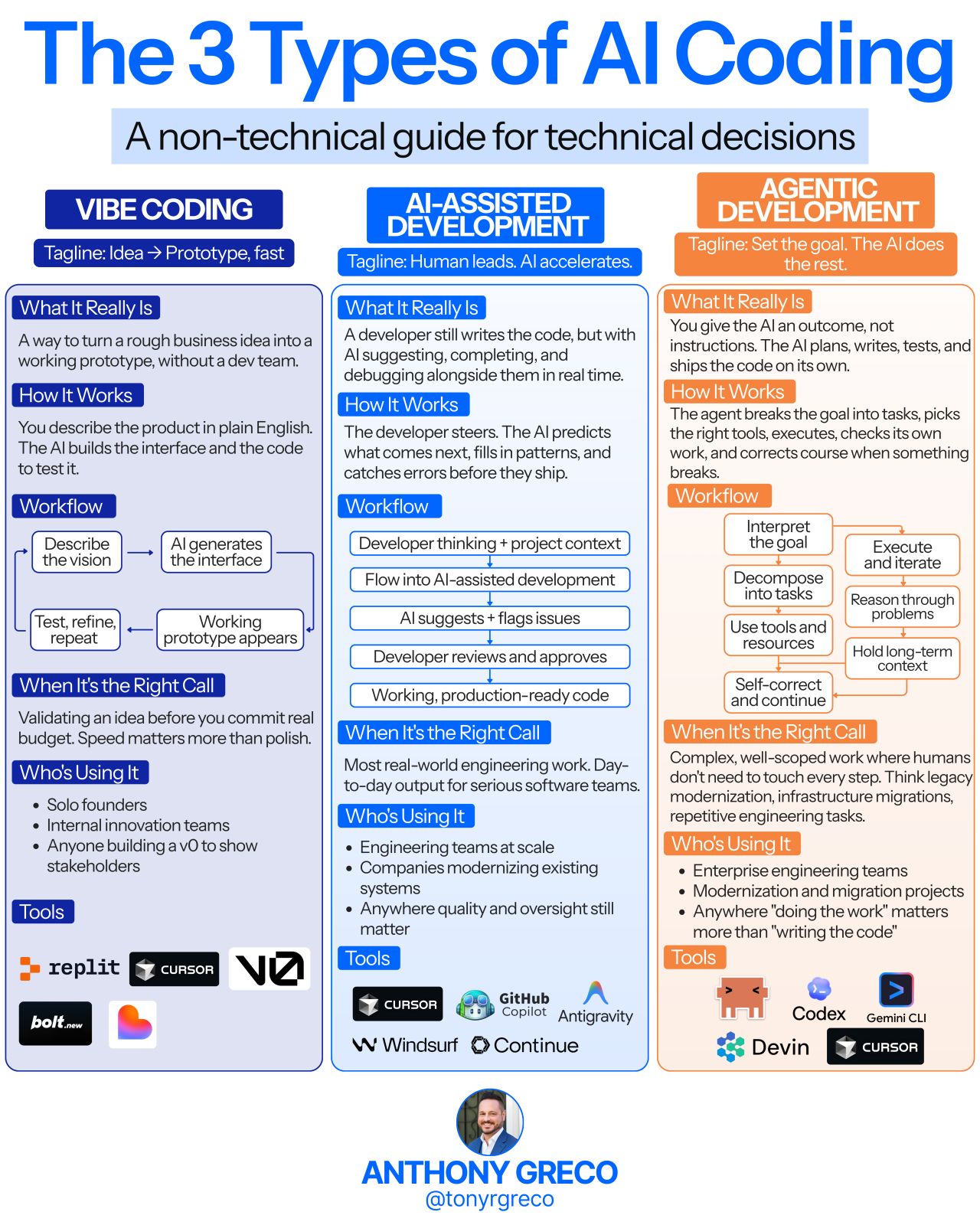
Vibe coding only works to a point. For complex systems, specification precision is crucial.
As of 2026, four “layers” are emerging in getting the code and tests produced by AI agents:
- Prompt Engineering (a.k.a. Prompt Construction)
- Context Engineering
- Intent Engineering (a.k.a. Intent Alignment)
- Agentic Engineering (a.k.a. Workflow Architecture)
You can find details at: MindStudio and Elastic Search Labs. Or this article with tips on doing good context engineering. For now, here’s a little table of the main ideas:
| Prompt Engineering | Context Engineering | Intent Engineering | Agentic Engineering |
|---|---|---|---|
| Crafting effective prompts to elicit desired responses (including precise output formats). | Providing relevant information and context to to improve understanding and response quality. | Aligning AI model outputs with user intentions and goals. | Designing and developing AI agents that can plan, use tools, and perform specific tasks and functions autonomously. |
| Think: Instructions | Think: Necessary information | Think: Goal Definition | Think: Orchestration |
| Focus: Tone, structure, basic examples, persona, how to “talk” to the model. | Focus: What the model needs to know to carry out the tasks. | Focus: Alignment of AI actions with the correct user goals. | Focus: Managing state, multi-step reasoning, autonomous decision-making, error handling and recovery. |
| Techniques: prompt templates, few-shot learning, iterative refinement. | Techniques: context windows, knowledge graphs, external data sources. | Techniques: reinforcement learning, reward modeling, user feedback loops. | Techniques: multi-agent systems, task decomposition, autonomous decision-making. |
There are many resources available that will show you, for each layer, best practices (and common mistakes). Mistakes can be quite costly!
But hang on, programming, or coding, is still something you should learn. Check out what Parth says near the end of this short:
Did you catch that?
“Know how to code before you let [AI] code for you.”
Ethics
The two major professional societies for software engineers are the IEEE Computer Society and the ACM, and each have published codes of ethics. They should be read in full:
- ACM Code of Ethics and Professional Conduct
- ACM Software Engineering Code of Ethics and Professional Practice
- IEEE Computer Society Code of Ethics
If you like bullet point summaries, we got you covered! Read on.
Key principles (an oversimplification, but a good place to start):
- Act in the public interest
- Maintain professional competence
- Protect confidential data
- Avoid algorithmic bias
- Foster fair, collaborative working environments
Core Ethical Principles:
- [Public] Act consistently in the public interest and welfare.
- [Client and Employer] Act in the best interests of clients and employers, while maintaining ethical standards.
- [Product] Build high-quality products that meet professional standards.
- [Judgment] Maintain integrity and independence in professional judgment.
- [Management] Promote ethical approaches when managing and leading software teams.
- [Profession] Advance the integrity and reputation of the software engineering profession.
- [Colleagues] Be fair and supportive of colleagues.
- [Self] Participate in lifelong learning and ethical practice.
Themes:
- [Bias Mitigation] Actively mitigate prejudices within datasets to avoid discriminatory software, particularly in recruiting, finance, and health care.
- [Privacy & Data Protection] Safeguard user data and adhere to privacy laws.
- [Safety & Security] Develop robust, secure systems to prevent exploitation, confidentiality breaches, data update or destruction, and system failures.
- [Ethical Design] Create systems that respect user boundaries and enhance well-being.
Professional Responsibilities:
- [Competence] Only take on work within your expertise.
- [Growth] Continuously update your skills and knowledge.
- [Accountability] Take responsibility for your actions and decisions.
- [Transparency] Disclose potential project failures, safety risks, or ethical conflicts.
- [Attribution] Respect copyrights, licenses, patents, and the intellectual work of others.
You can find another short summary at Fellow.ai.
Computer Science vs. Software Engineering
While computer science and software engineering are related, it’s good to keep the following in mind:
| Computer Science | Software Engineering |
|---|---|
| The study of computing and computation. Theory, logic, math, algorithms, AI, general principles. | Practical application of engineering principles to design, develop, and maintain software systems through their lifecycle. |
| Emphasizes understanding the underlying concepts and foundations of computing. | Emphasizes the systematic approach to software development, including project management, design, testing, and maintenance. |
| Involves research, experimentation, and the exploration of new technologies. | Involves hands-on application of established methodologies and best practices to create reliable and efficient software solutions. |
| Studies include artificial intelligence, machine learning, and theoretical computer science. | Studies include software architecture, software testing, and software project management. |
| Practitioners design and implement algorithms and communications protocols, conduct experiments, architect systems, perform research in data science and artificial intelligence, perform security analyses, explore new technologies. | Practitioners design, develop, test, deploy, and maintain software systems. |
Recall Practice
Here are some questions useful for your spaced repetition learning. Many of the answers are not found on this page. Some will have popped up in lecture. Others will require you to do your own research.
- What is software engineering? The systematic application of engineering approaches to the development of software.
- What is programming? The conversion of specifications into executable code.
- Marina Wyss mentions that AI is really good at programming, but there are things that humans excel at in the software engineering process. What are those things? Design, reliability, tradeoff analysis, cross functional collaboration, and incident response.
- What are some of the phases of the Software Development Life Cycle (SDLC)? Ideation, Planning, (Requirements) Analysis, Design, Implementation, Code Review, Testing, Documentation, Integration, Deployment, Maintenance, Evaluation, Retirement, Disposal.
- What are the two major approaches to software development? Waterfall and Agile.
- What are some common agile frameworks? Scrum, Kanban, Lean, Six Sigma, and Extreme Programming (XP).
- Name several technical skills important for software engineers. Languages, frameworks, agent orchestration, version control, testing, debugging, design patterns, command line interfaces, project management.
- The term “soft skills” has been around a while, but there are at least two better terms. What are they? (1) Durable Human Skills and (2) Power Skills.
- Name as many durable human skills as you can. Communication, collaboration, inclusion, problem-solving, creativity, adaptability, empathy, ethical awareness, critical thinking, leadership, time management, emotional awareness, self-management, continuous learning.
- Is there a security analysis phase of the SDLC? Why or why not? Security analysis should be integrated throughout the SDLC rather than being a separate phase. Security must be built-in to the entire software development process.
- What are the three types of AI coding mentioned by Tony Greco? Vibe coding, AI-assisted development, and agentic development.
- What are the four layers of agentic development? Prompt engineering, context engineering, intent engineering, agent orchestration.
- What two professional organizations provide codes of ethics for software engineers? The Association for Computing Machinery (ACM) and the Institute of Electrical and Electronics Engineers (IEEE).
- What are the 8 categories of principles of software engineering ethics (from the ACM/IEEE code)? Public, Client and Employer, Product, Judgment, Management, Profession, Colleagues, Self.
Summary
We’ve covered:
- What software engineering is
- What software engineers do
- The systems development lifecycle
- Project initiation
- Implementing software systems
- Ethical concerns and published Codes of Ethics