Introduction to Distributed Programming
Definitions
Distributed Computing is computing on a distributed system.
A Distributed System is a system of computers communicating via messages over a network so as to cooperate on a task or tasks. There’s no physical shared memory in a distributed system, though algorithms can simulate such a thing.
Areas of Study
Here are a few areas we’ll cover:
- Networks and Internets
- Distributed Algorithms and Transactions
- Paradigms
- Enterprise Computing
- Grid Computing
- Programming Languages
Networks and Internets
This is a big topic, so there’s a separate page of notes.
Distributed Algorithms
Distributed algorithms are designed for programming distributed systems. Unlike centralized algorithms, distributed algorithms are unaware of any global state or a global time frame. When designing such algorithms we have to consider:
- Modeling: transition systems, state diagrams, temporal logic
- Communication, Timing, and Synchronization
- Routing
- Virtual Circuits vs. Packet Switching
- Paradigms: wave algorithms, traversal algorithms, election algorithms, snapshot algorithms
- Transactions
- Distributed Termination Detection
- Distributed Deadlock Detection
- Distributed Failure Detection
- Fault Tolerance
- Stabilization
Distributed Computing Paradigms
Paradigms are the different approaches to structuring and programming distributed systems. Here are a few:
- Client-server
- Multi-tier
- Peer-to-peer
- Publish/subscribe
- RPC
- Distributed Objects
- Object Spaces
- Mobile Agents
- Network Services
- Groupware
Enterprise Computing
Enterprise applications are applications that run on large servers with multiple (simultaneous) users communicating over a network via clients like web browsers, PDAs, cell phones, or desktop applications. These applications generally read from and write to big databases.
Some people say enterprise applications are only for business functions (accounting, customer management, product tracking, etc.); some say any big distributed application counts as “enterprise”.
Enterprise Computing Platforms
In the old days, “big systems” like IMS and CICS were run on big mainframes, often programmed in COBOL. In the 1990s and early 2000s a couple new big players emerged: Java EE and .NET, with these features:
| Java EE | .NET |
|---|---|
|
|
Enterprise Architectures
In the old days, and today for the most trivial of applications, we see client-server organizations.
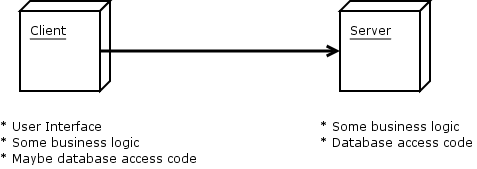
Two tier architectures are almost always way too fragile. They soon gave way to three-tier architectures:
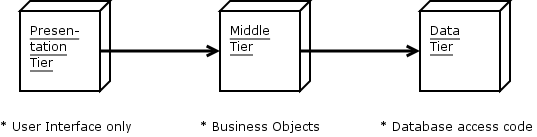
The idea here is that any one of the three layers can be completely re-implemented without affecting the others.
The middle layer completely isolates the front end from any knowledge of the database. The UI doesn’t even know what the data source is. It just makes calls like fetchCustomerById(24337).
Software running in the middle tier is called middleware. Middleware products are also called containers, since they host and manage the business objects. They can manage lifecycles, transactions, memory, authentication, concurrency, distribution, security, sessions, resource pooling, logging and lots of other “system-level plumbing things” so developers only have to concentrate on business logic.
There’s no need to stop at three tiers. You’ll often hear the term n-tier.
Sometimes applications are classified by the complexity of the client:
| Thick Client | Thin Client |
|---|---|
|
|
Grid Computing
The term grid computing refers to the computation of highly compute-intensive algorithms (protein folding, SETI, earthquake simulation, climate modeling) over many computers across administrative domains. Most of the computers run similar code; they’re all contributing bits toward the overall solution.
More at Wikipedia’s article on Grid Computing.
Language-Specific Distributed programming
This paper by Henri Bal, Jennifer Steiner, and Andrew Tannenbaum from 1989, covers dozens of languages. A good read!
Here is how they categorize the covered languages:
TODO TABLE
Naturally, a lot of new languages have arrived since then!
Mainstream languages in wide use tend to provide support for distributed programming both within the language itself and in libraries. Here is where to look:
| Language | Distributed Programming Support |
|---|---|
| Erlang | Built-in support for distributed programming, fault tolerance, and concurrency. TODO links |
| Ada | Has built-in support for distributed systems, including tasking and real-time features. TODO links - distributed programming annex |
| Perl | Has modules like Parallel::ForkManager and POE for distributed programming. TODO links - e.g., perlnet |
| Go | Built-in support for concurrency and networking, making it suitable for distributed applications. TODO links |
| Scala | Often used with frameworks like Akka for building distributed systems. TODO links |
| Elixir | Built on the Erlang VM, it inherits Erlang's capabilities for distributed programming. TODO links |
| Java | With libraries like RMI (Remote Method Invocation) and frameworks like Spring, it supports distributed programming. TODO links |
| Python | Has libraries like Pyro and Dask for distributed computing. TODO links |
| Rust | Has libraries like Tokio and Actix for building distributed systems. TODO links |
| C | While not inherently distributed, it can be used with libraries like MPI (Message Passing Interface) for distributed computing. TODO links |
| C++ | Can be used with libraries like Boost.Asio and ZeroMQ for distributed applications. TODO links |
| Ruby | Has libraries like DRb (Distributed Ruby) for building distributed applications. TODO links |
| JavaScript | With Node.js and libraries like Socket.io, it supports real-time distributed applications. TODO links |
| C# | With libraries like WCF (Windows Communication Foundation) and ASP.NET Core, it supports distributed programming. TODO links |
| PHP | Can be used with libraries like Ratchet for real-time distributed applications. TODO links |
| Swift | With libraries like SwiftNIO, it supports building distributed applications. TODO links |
| Kotlin | With libraries like Ktor and coroutines, it supports building distributed applications. TODO links |
| Haskell | With libraries like Cloud Haskell, it supports distributed programming. TODO links |
| Julia | With libraries like Distributed.jl, it supports parallel and distributed computing. TODO links |
Summary
We’ve covered:
- What distributed computing is
- Areas of study
- Concerns of distributed algorithms
- Paradigms for distributed computing
- Enterprise computing
- Grid computing
- Distributed programming in various languages